How to Calculate Average Speed for Regularity Rallies
Calculate average speed for regularity rallies: formulas for time, distance and speed, km/h to m/s conversion and worked examples with solutions.
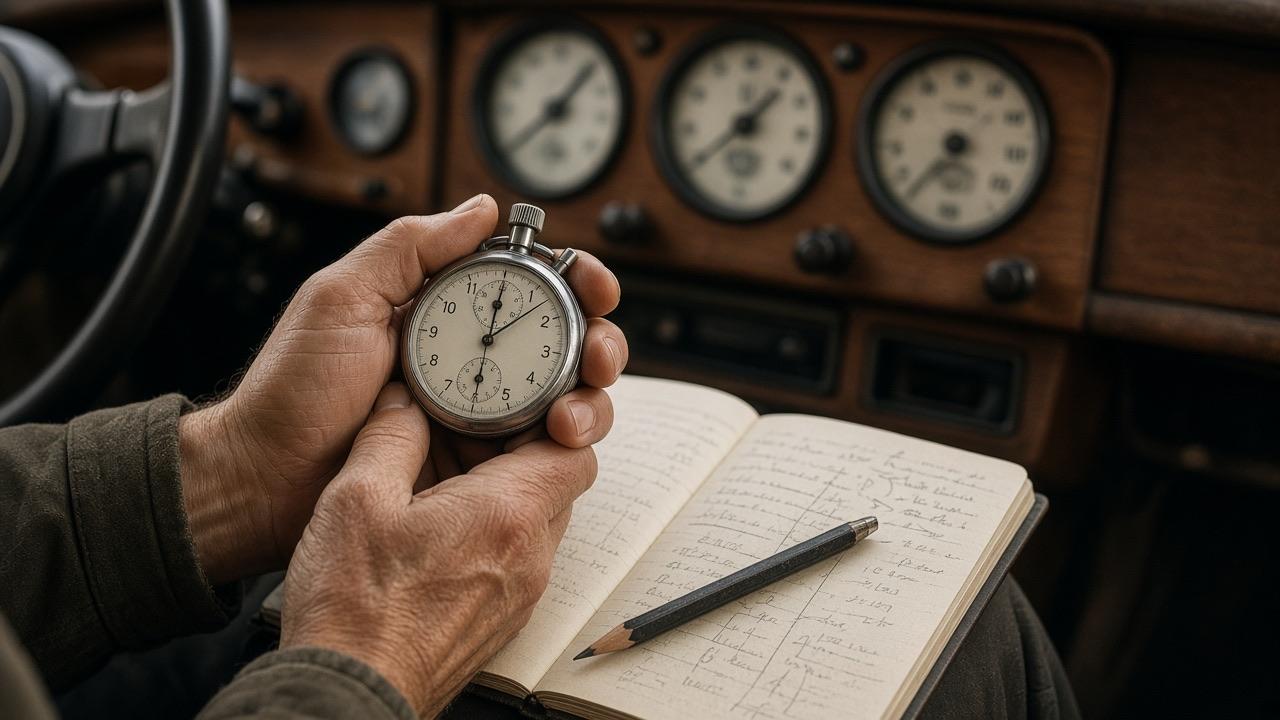
You calculate average speed with one simple formula: speed equals distance divided by time, v = s / t. On a rally you usually need it the other way round, t = s / v, because that gives you the target time. Example: 2.4 km at 36 km/h takes exactly 4:00 minutes. If you would rather not do the maths yourself, use the average speed calculator.
The three basic formulas
In every regularity test three values are linked: distance, time and average speed. Know two and you can work out the third.
| You need | Formula | Typical case |
|---|---|---|
| Time t | t = s / v | Roadbook gives distance and average |
| Average v | v = s / t | Roadbook gives distance and time |
| Distance s | s = v × t | Where should I be after x seconds? |
The first case is the most common. The result is your target time.
Converting km/h, m/s and seconds per 100 m
Working in hours is awkward when you care about seconds. These conversions help:
- km/h to m/s: divide by 3.6. 36 km/h is 10 m/s.
- Seconds per kilometre: 3600 / v. At 36 km/h that is 100 seconds.
- Seconds per 100 m: 360 / v. At 36 km/h that is 10 seconds.
| Average | m/s | Seconds per 100 m | Seconds per km |
|---|---|---|---|
| 30 km/h | 8.33 | 12.0 | 120.0 |
| 36 km/h | 10.00 | 10.0 | 100.0 |
| 40 km/h | 11.11 | 9.0 | 90.0 |
| 45 km/h | 12.50 | 8.0 | 80.0 |
| 48 km/h | 13.33 | 7.5 | 75.0 |
| 50 km/h | 13.89 | 7.2 | 72.0 |
With the seconds per 100 m column the co-driver can do the maths in their head. If your event uses miles, the same formulas work with miles and mph.
Example 1: target time from distance and average
The test is 5.3 km long and the average is 42 km/h.
- t = 5.3 / 42 = 0.12619 hours
- 0.12619 × 3600 = 454.3 seconds
- 454.3 seconds is 7:34.3 minutes
Cross-check in m/s: 42 / 3.6 = 11.667 m/s. 5300 / 11.667 = 454.3 seconds. Correct.
Example 2: average from distance and time
The roadbook says 3.2 km in 5:20 minutes.
- 5:20 minutes is 320 seconds
- v = 3200 m / 320 s = 10 m/s
- 10 × 3.6 = 36 km/h
Example 3: where should you be after 2:30?
The average is 48 km/h and the stopwatch shows 2:30, which is 150 seconds.
- 48 / 3.6 = 13.333 m/s
- s = 13.333 × 150 = 2000 m
If your tripmaster reads 2.05 km at that moment, you are 50 m ahead, so you are driving too fast.
Average changes in the middle of a test
Many organisers change the average part way through a test. This average change is a classic source of errors. Example:
- 0 to 3.0 km at 40 km/h
- 3.0 to 5.0 km at 30 km/h
First part: 3.0 / 40 × 60 = 4.5 minutes, so 4:30. Second part: 2.0 / 30 × 60 = 4 minutes. Target time at the finish is 8:30.
Where should you be at 4.0 km? Carry on from the change point: 4:30 plus 1.0 km at 30 km/h (2:00) gives 6:30. The usual mistake is to calculate the whole 4.0 km at the new average. That gives 8:00, and you would be 90 seconds out.
One more trap: the overall average is not simply the mean of 40 and 30. Over 5 km in 8:30 it works out at 35.3 km/h, not 35 km/h. Never average the averages. Add up the times.
Turning deviation into metres
Your time deviation can also be expressed in metres. At 36 km/h one second equals 10 metres. If you are 50 m ahead, you are 5 seconds early. At 50 km/h it is 13.9 m per second. The higher the average, the more distance each second covers.
Avoiding rounding errors
- Work in seconds and metres internally, not in decimal minutes.
- Round only at the very end, ideally to tenths or hundredths.
- With several sections, add up the times, not rounded averages.
- Check your distances. An uncalibrated odometer makes every calculation inaccurate. See how to calibrate your odometer.
In practice
There is no time for long sums during a rally, so prepare your tests the evening before. The calculator builds printable average speed tables for you. Our guide on average speed tables explains how to use them in the car.
In Rally Co-Pilot you enter two of the three values, the app calculates the third and counts down the target time while you drive.
Terms in this guide
Read next
Average Speed Tables: How to Build and Use Them
Build an average speed table for regularity rallies: layout, step size, average changes and tips for using it in the car. With a printable generator.
How to calibrate your odometer for a rally
How to calibrate your odometer for a rally: drive the calibration route, work out the correction factor and avoid costly errors. With a worked example.
Rally app or tripmaster? What you actually need
Rally app or tripmaster? An honest comparison for classic rallies: accuracy, installation, GPS reception, regulations and when each one makes sense.