Average Speed Tables: How to Build and Use Them
Build an average speed table for regularity rallies: layout, step size, average changes and tips for using it in the car. With a printable generator.
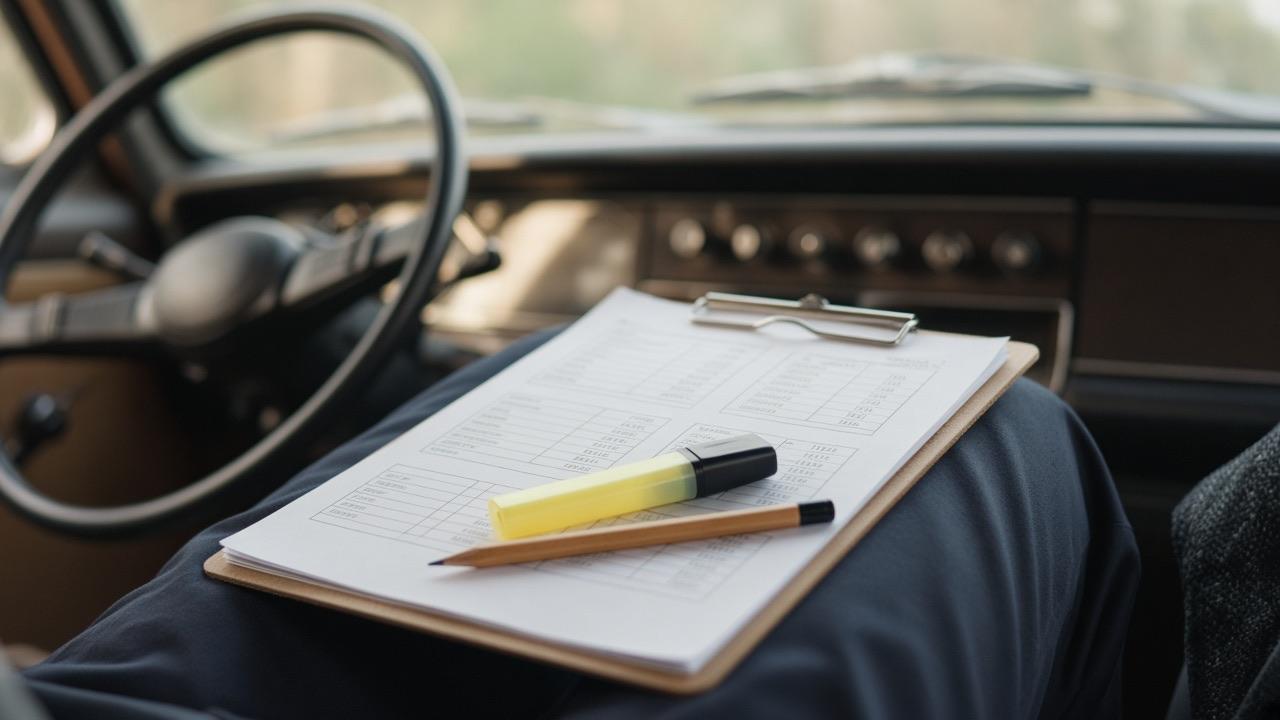
An average speed table tells you, for one given average, where you should be at what time. Instead of doing sums during a test, the co-driver simply reads it off: at 1.5 km the stopwatch should show 2:30. The average speed calculator builds these tables in seconds and lets you print them.
How an average speed table works
An average speed table has two columns: distance travelled and the matching target time. Each table is valid for exactly one average speed. Here is an extract for 36 km/h:
| Distance | Target time |
|---|---|
| 0.10 km | 0:10 |
| 0.50 km | 0:50 |
| 1.00 km | 1:40 |
| 1.50 km | 2:30 |
| 2.00 km | 3:20 |
| 2.40 km | 4:00 |
| 3.00 km | 5:00 |
36 km/h is easy, because every 100 m takes exactly 10 seconds. Awkward averages are harder, and that is where a table earns its place.
The formula behind it
Each row is t = s × 3600 / v, where s is the distance in kilometres, v the average in km/h and t the result in seconds. For 42 km/h it looks like this:
| Distance | Seconds | Target time |
|---|---|---|
| 0.50 km | 42.9 | 0:42.9 |
| 1.00 km | 85.7 | 1:25.7 |
| 1.50 km | 128.6 | 2:08.6 |
| 2.00 km | 171.4 | 2:51.4 |
| 2.50 km | 214.3 | 3:34.3 |
| 3.00 km | 257.1 | 4:17.1 |
For the full derivation and unit conversions, see how to calculate average speed.
Choosing the step size
How fine your table needs to be depends on the test:
- 100 m: the standard for most tests. Easy to read and precise enough.
- 50 m: useful at low averages or when scoring is to the hundredth.
- 500 m or 1 km: fine for long transport sections where you just want to stay roughly on schedule.
There is no point being finer than your instrument. If your tripmaster only shows 10 m steps, a 10 m table adds nothing.
Handling an average change
If the average changes within a regularity test, the second part needs its own table. It does not start at zero. It starts at the target time at the change point.
Example: 40 km/h up to 3.00 km, then 30 km/h. The target time at the change point is 4:30. From there, at 30 km/h, every 100 m takes 12 seconds:
| Distance | Target time |
|---|---|
| 3.00 km | 4:30 |
| 3.50 km | 5:30 |
| 4.00 km | 6:30 |
| 4.50 km | 7:30 |
| 5.00 km | 8:30 |
Mark the average change in large, coloured writing. Miss it and you are far off within a few hundred metres.
Using the table in the car
- Start the stopwatch exactly at the start of the test and zero the tripmaster.
- The co-driver reads the distance at fixed intervals, for example every 100 m.
- They compare the stopwatch with the table and call the deviation: "two seconds early".
- The driver corrects smoothly. Small corrections over a longer distance beat hard braking.
This only works if your distance is right. Without calibration of your tripmaster, even a perfect table will not match the organiser's route.
Practical tips
- One table per average, clearly labelled.
- Large print, so you can read it through corners.
- Laminate it or slip it into a clear sleeve.
- Highlight full kilometres to find the right row faster.
- Print spare tables for averages that are common at that event.
Some organisers include their own tables in the roadbook. Check those too before you rely on them.
Table or app?
| Paper table | GPS app | |
|---|---|---|
| Preparation | Print one per average | Enter or scan the values |
| In the car | Read and compare | Deviation shown live |
| Failure proof | Yes, no battery needed | Needs power and GPS reception |
| Permitted | Almost everywhere | Depending on the regulations |
Many crews use both: the app as the main instrument and a table as backup. Our comparison of app vs tripmaster covers this in more detail.
In practice: your table in five minutes
Open the calculator, enter the average and the step size, and print the table. Do this for every average in the roadbook the evening before, and at the start you only need to turn to the right page. Check the rally calendar to see what is coming up next.
Rally Co-Pilot can also turn a photo of an average speed table page into sections with distance and target speed, using its AI roadbook scanner.
Terms in this guide
Read next
How to Calculate Average Speed for Regularity Rallies
Calculate average speed for regularity rallies: formulas for time, distance and speed, km/h to m/s conversion and worked examples with solutions.
Rally app or tripmaster? What you actually need
Rally app or tripmaster? An honest comparison for classic rallies: accuracy, installation, GPS reception, regulations and when each one makes sense.

Co-driver tips for regularity rallies
Co-driver tips for regularity rallies: preparation, a tidy cockpit, clear calls to your driver, and what to do when you take a wrong turn.