Time controls, time cards and penalty points explained
Time controls, time cards and penalty points at a classic rally explained: working out your due time, grace time, stamp controls and scoring.
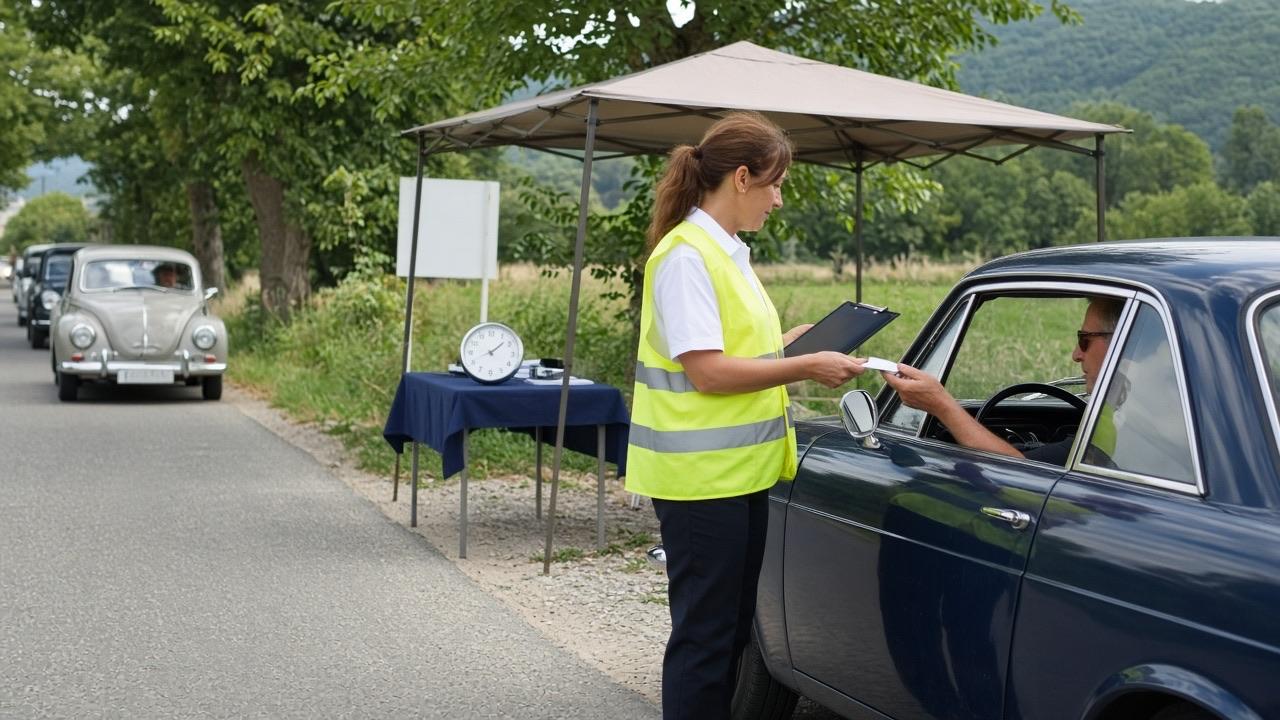
A time control checks that you arrive at a set point on the route in the right minute. Your time card is the record: every time and every stamp goes on it. You collect penalty points for arriving early or late, for missing stamps and for deviations on the tests. The crew with the fewest points at the end wins.
The time card: your most important document
You receive the time card at the start. The co-driver usually looks after it. At each control, marshals write down a time or add a stamp. At the end of a leg, you hand it in.
Lose the card or miss an entry and, depending on the regulations, it can cost a lot of points or even your classification. So:
- Keep it in a clear plastic sleeve.
- Always put it back in the same place.
- Check every entry before you drive off.
Time controls (TC)
Between two time controls lies a leg with a fixed target duration. Your departure time at one TC plus that duration gives your due time at the next one.
Worked example
- Departure from TC 1: 9:12
- Target duration to TC 2: 47 minutes
- Due at TC 2: 9:12 + 0:47 = 9:59
If you leave TC 2 straight away and the next leg is 1 hour 8 minutes, you are due at TC 3 at 9:59 + 1:08 = 11:07. Whether the departure time at a TC equals the arrival time, or there is a break in between, is set out in the roadbook.
At a TC, the whole minute usually counts. Arrive at 9:59:40 and you are in your minute, so you are on time. The control area is often marked with signs. At many events you may only enter it shortly before your start time or due time. The exact rule is in the regulations.
Early or late?
Both cost you. At many rallies, arriving early is penalised more heavily than arriving late, because it suggests you drove too fast. Each organiser sets its own points per minute.
Grace time
Grace time is the window in which you can still check in at a TC without dropping out of the results. Being late within the grace time costs points. Go beyond it and, depending on the regulations, you miss the control or are no longer classified. Grace time can also add up across several controls.
Passage controls and stamp controls
Not every control records time.
- Passage control (PC): It confirms that you followed the set route. A marshal records that you came through.
- Stamp control: You get a stamp on your time card. Sometimes there is just a board with a letter or symbol at the roadside that you note down yourself.
A missing stamp can be expensive, depending on the regulations. At many rallies, missing entries ruin more results than the seconds lost on tests.
Penalty points on tests
On a regularity test, your deviation from the target time is measured. This happens at the finish, at intermediate points and at secret checks. Each deviation is turned into penalty points on a fixed scale: per second, per tenth or per hundredth. There is often a cap per timing point.
Worked example
Assume the regulations give 1 point per tenth of a second. A test has three timing points:
| Timing point | Deviation | Points |
|---|---|---|
| Secret check 1 | +0.4 s | 4 |
| Secret check 2 | −1.2 s | 12 |
| Finish | +0.3 s | 3 |
| Total | 19 |
Early or late makes no difference here. Only the size of the deviation counts.
Some organisers also apply a coefficient to balance out the age of the car. With an assumed factor of 0.9, 19 points become 19 × 0.9 = 17.1 points. How the coefficient works is set out in the regulations.
Who wins?
Points from tests, time controls and any other penalties are added up. The lowest total wins. Ties are broken by a rule in the regulations, for example the better result on a particular test.
How to avoid needless points
- Work out TC times in advance. Write every due time into the roadbook before the start.
- Use official time. Sync your watch with the official time.
- Plan a buffer. Get close to the TC a little early and wait before the control area.
- Check the time card. Every entry legible and correct? Then drive on.
- Stay calm. Sort out any disagreement with the clerk of the course, not at the control.
How tests are timed is covered in How rallies measure time. For tips on working the cockpit, see Co-driver tips. Planning your first event? Read Your first classic rally. Upcoming dates are in the rally calendar.
Terms in this guide
Read next

How rallies measure time: light barriers, hoses, GPS
How rallies measure time: light barriers, pressure hoses, GPS trackers and secret checks explained, plus what each method means for your driving.

Co-driver tips for regularity rallies
Co-driver tips for regularity rallies: preparation, a tidy cockpit, clear calls to your driver, and what to do when you take a wrong turn.
Your First Classic Car Rally: Preparation and Checklist
Your first classic car rally: what to sort out beforehand, what to pack in the car and how rally day works. Includes a practical checklist.