Rally app or tripmaster? What you actually need
Rally app or tripmaster? An honest comparison for classic rallies: accuracy, installation, GPS reception, regulations and when each one makes sense.
To get started in regularity rallies, a good rally app on your phone's GPS is enough. A classic tripmaster with a wheel sensor has the edge if you often drive through forests and tunnels, want your distances to match the organiser's measurement exactly, or the regulations do not allow GPS devices. Here is an honest comparison.
What a tripmaster does
A tripmaster is a permanently fitted measuring instrument. Depending on the model, a sensor picks up distance from a wheel, the gearbox or the speedometer cable. Because it counts wheel turns, it does not need satellite reception.
Through calibration on the calibration route, you match it to the organiser's measuring car. Simple units only show trip and total distance. More advanced rally computers also work with average speed and target time.
What a rally app does
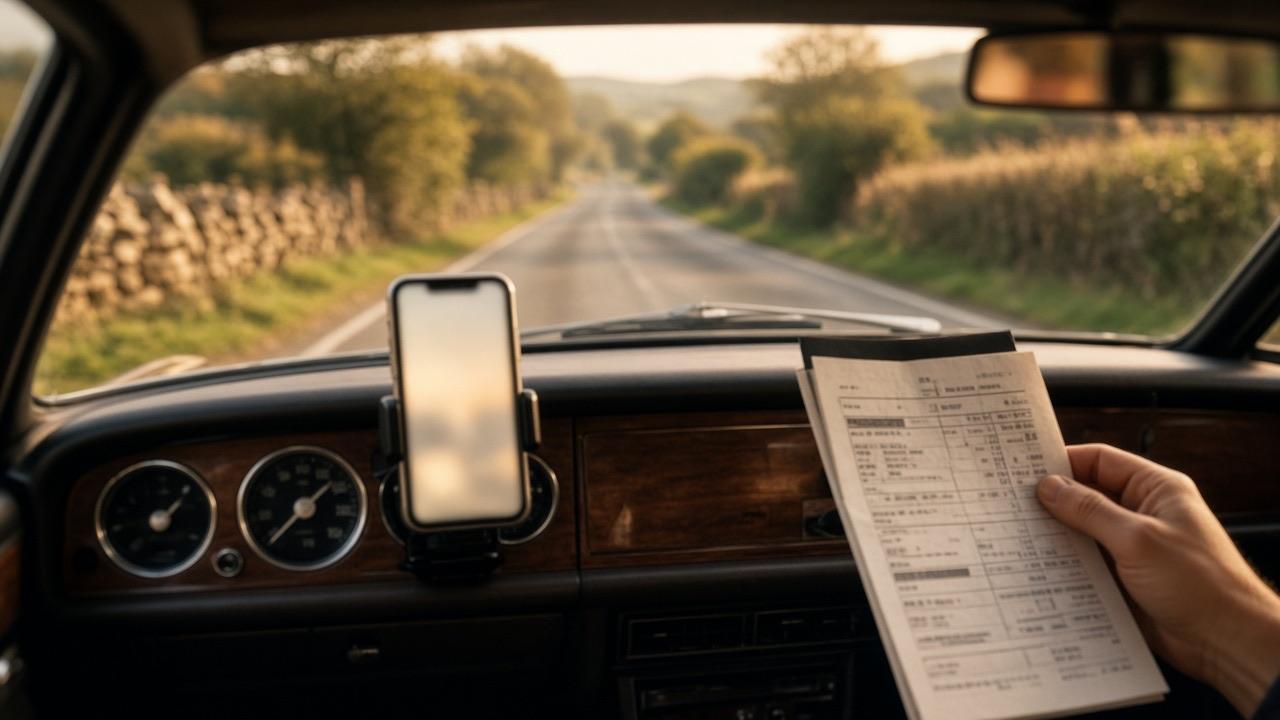
A rally app runs on your phone and measures distance by GPS. Rally Co-Pilot, for example, works out your target time from average speed and distance, counts it down and shows your live deviation in metres or seconds. You see straight away whether you are ahead of or behind target.
On top of that, it has features a classic instrument does not:
- AI roadbook scanner: Photograph a roadbook or speed table page and the app turns it into sections with distance and target speed. You review everything before importing. It runs entirely on the iPhone and needs iOS 26 and a device with Apple Intelligence.
- Apple Watch: Countdown, time deviation and speed on your wrist while the iPhone stays in its mount.
- Remote triggers: Start with the volume buttons, a Bluetooth camera remote, or a PlayStation or Xbox controller. The controller can also stop a test.
- Live Activities: Remaining time, average and distance on the lock screen.
- Timers: As many stopwatches and countdowns as you like, for example for time controls.
Side by side
| Criterion | Tripmaster | App with iPhone GPS | App with RaceBox |
|---|---|---|---|
| Installation | Sensor, wiring, mounting | None | None, pairs via Bluetooth |
| Distance measurement | Wheel sensor | GPS | GPS at 25 updates per second |
| Forest, tunnels, deep valleys | Independent of reception | Reception can suffer | Still needs open sky |
| Matching the roadbook | Adjustable via correction factor | Can differ from the measurement | Can differ from the measurement |
| Live target time and deviation | Depends on model | Yes | Yes |
| Changing cars | Needs refitting | Phone moves with you | Phone and RaceBox move with you |
| Regulations | Depends on class | Depends on class | Depends on class |
When a tripmaster is the better choice
Be honest with yourself. In these cases, a wheel sensor makes a lot of sense:
- You compete to the hundredth and your rallies often run through dense forest, tunnels or narrow valleys. GPS can struggle there. A wheel sensor does not.
- Your regulations ban GPS. Some events or classes restrict GPS devices and smartphones. Read the regulations carefully.
- You want to match the organiser's measurement exactly. With a correction factor, your odometer effectively counts like the measuring car. GPS measures the distance you actually drove, which can differ slightly.
- One car, many rallies. A permanent installation that is always there is worth it.
When the app is enough, or even better
- You are just starting out. You want to find out whether you enjoy the sport before fitting hardware.
- You switch cars. The phone simply comes along.
- You do not want to alter the original. No drilling, no wiring in a historic vehicle.
- You want to see live where you stand. Deviation in metres or seconds helps you correct early instead of guessing.
- You want less typing. The roadbook scanner saves entering speed tables just before the start.
The middle ground: app plus RaceBox
If your iPhone's GPS feels too slow, you can connect a RaceBox Mini, Mini S or Micro via Bluetooth. It delivers 25 position updates per second. If its signal drops, Rally Co-Pilot switches back to the iPhone's GPS automatically. Subscribers get a 20 percent discount code for the RaceBox store.
To be fair, though: a RaceBox is still a GPS receiver. In a long tunnel it has no reception, just like the phone.
Common misconceptions
- "GPS is too inaccurate for rallies." On open roads, modern GPS is good. The weak spots are poor reception and the gap to the organiser's measurement.
- "A tripmaster does all the maths for me." Basic units only measure distance. You then work out time yourself with an average speed table and a stopwatch.
- "I need both." Maybe, maybe not. Plenty of crews combine a tripmaster for distance with an app for time and countdown.
How to decide
- Read the regulations for your next rally: what is allowed in your class?
- Look at the route: lots of forest and tunnels, or open country?
- Start with the app and drive the calibration route too. You will see how well the GPS distance matches the official one. More in How to calibrate your odometer.
- If you keep losing points to distance errors, a tripmaster is the next step.
To learn how organisers do their own timing, read How rallies measure time. New to all this? Start with Your first classic rally. And your next chance to try it out is waiting in the rally calendar.
Terms in this guide
Read next
How to calibrate your odometer for a rally
How to calibrate your odometer for a rally: drive the calibration route, work out the correction factor and avoid costly errors. With a worked example.
How rallies measure time: light barriers, hoses, GPS
How rallies measure time: light barriers, pressure hoses, GPS trackers and secret checks explained, plus what each method means for your driving.
Your First Classic Car Rally: Preparation and Checklist
Your first classic car rally: what to sort out beforehand, what to pack in the car and how rally day works. Includes a practical checklist.